

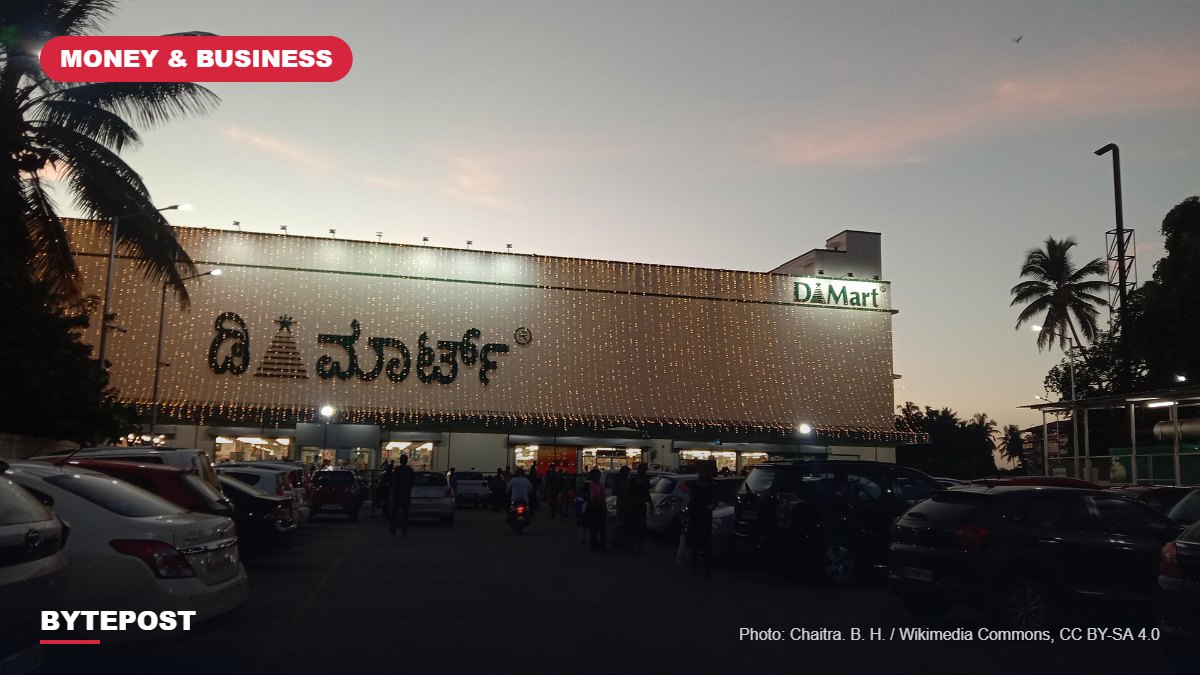
DMart sells groceries cheaper than most shops around it, rarely runs flashy sales and barely advertises. So how did it earn close to ₹3,000 crore in profit last year?
The short answer is that DMart keeps only about ₹4 out of every ₹100 you spend there, but it collects that ₹4 from a very large number of very full trolleys. Here is the maths, using the company’s latest reported numbers.
The answer in brief
- Tiny margin, huge volume: in the July–September 2026 quarter, DMart’s parent Avenue Supermarts earned a net profit of ₹743 crore on revenue of ₹19,644 crore, a margin of 3.8%.
- Low costs first, low prices second: the company calls its approach “Everyday Low Cost, Everyday Low Price”. Staff and running costs together took less than ₹8 of every ₹100 of sales.
- Food brings you in, other things earn more: food and grocery was 56.9% of sales in April–September 2026. General merchandise and clothing made up 23.6%.
- Fast-moving stock: goods sit for about 37 days and suppliers are paid in about 8 days, on FY26 figures.
Who owns DMart?
DMart is the store brand of Avenue Supermarts Ltd. It was founded by investor Radhakishan Damani, who is also the chairman, and its first store opened in Powai, Mumbai, in 2002. The company listed on the stock exchanges in March 2017.
Growth has been steady instead of sudden. According to the company history on Wikipedia, DMart had 29 stores in 2010, crossed 300 in 2022 and touched 500 in April 2026. At the end of September 2026 it had 518 stores with 21.4 million square feet of retail space. The promoter group still held 74.48% of the company at that point, according to Screener data.
Where every ₹100 you spend goes
The company does not publish a simple “per ₹100” break-up, so the table below is our estimate. We took the consolidated results for the quarter ended 30 September 2026 and divided each reported cost by revenue of ₹19,644 crore.
| Where the money goes | Out of every ₹100 (estimated) | Reported amount, Q2 FY27 |
|---|---|---|
| Buying the goods and related costs | About ₹85 | Worked out as the balance |
| Other expenses (rent, power, transport, upkeep and more) | ₹5.6 | ₹1,091.83 crore |
| Staff | ₹2.3 | ₹447.14 crore |
| Operating profit (EBITDA) | ₹7.1 | ₹1,393 crore |
EBITDA is profit before interest, tax and depreciation. That ₹7.1 is not what the company keeps. It is then split roughly like this:
| From the ₹7.1 of operating profit | Out of every ₹100 (estimated) | Reported amount, Q2 FY27 |
|---|---|---|
| Depreciation (wear and tear on stores and equipment) | ₹1.6 | ₹317.75 crore |
| Interest on loans | ₹0.3 | ₹63.90 crore |
| Tax and other items, net of other income | About ₹1.4 | Worked out as the balance |
| Net profit | ₹3.8 | ₹743 crore |
How we worked it out: each reported figure divided by revenue, rounded to one decimal. “Buying the goods” and “tax and other items” are balancing figures, not numbers the company reported, so treat them as approximate.
The picture is clear even with rounding. Roughly ₹85 of your ₹100 goes straight back to buying the products. DMart runs the whole business, pays its people, builds its stores and pays its taxes out of the remaining ₹15 or so.
Trick 1: keep costs boringly low
Brokerage and news reports describe DMart’s model as “Everyday Low Cost, Everyday Low Price” (EDLC-EDLP). The order matters. The company first tries to buy cheaper and run cheaper than rivals, and then passes a part of that saving on as lower shelf prices every day, instead of running occasional big sales.
You can see the low-cost habit in the numbers: staff costs were only about 2.3% of sales last quarter, and all other running expenses about 5.6%.
Even so, costs are creeping up. MD and CEO Anshul Asawa said in the results statement, “Wage inflation at entry-level has led to a marginal increase in operating expenses.” Employee costs rose 18.7% from a year earlier, a little faster than sales.
Trick 2: sell fast, pay fast
Screener’s data from company filings shows two numbers that explain a lot:
- Inventory days: 37 in FY26. On average, stock is sold a little over a month after it arrives.
- Days payable: 8 in FY26. On average, suppliers are paid in about eight days.
Paying a supplier in a week, when much of retail takes far longer, is a strong bargaining chip when negotiating purchase prices. The filings we read do not put a number on the discount this earns, so we will not guess. But it fits the “low cost first” approach.
Trick 3: food pulls you in, the rest pays better
Food and grocery made up 56.9% of sales in the first half of FY27, non-food FMCG items such as soaps and detergents 19.5%, and general merchandise and apparel 23.6%.
Staples such as rice, oil and atta are what bring families in every month. Once you are inside with a trolley, the steel utensils, bedsheets, plastic boxes and children’s clothes are on the way to the billing counter. Retailers generally earn more on such items than on staples, although DMart does not disclose margins by category.
The trolleys are big. DMart recorded 11.1 crore customer bills in the July–September 2026 quarter, up from 9.7 crore a year earlier. Dividing quarterly revenue by the number of bills gives an estimated average bill of roughly ₹1,750. That is our calculation, not a company figure.
Trick 4: big stores, many of them owned
Wikipedia’s history of the company, citing older reports, says DMart chose to run larger stores than other Indian supermarkets and to own most of them instead of renting. Owning a store costs a lot at the start but removes rent increases later.
On current numbers, the average DMart store is about 41,000 square feet (21.4 million square feet divided by 518 stores, our estimate). Sales over the latest twelve months work out to very roughly ₹34,000–35,000 per square foot a year. This is a rough estimate because it mixes twelve months of sales with the floor area at the end of the period.
Three years in numbers
| Year (consolidated) | Sales | Operating profit | Net profit | Net margin |
|---|---|---|---|---|
| FY24 (April 2023–March 2024) | ₹50,789 crore | ₹4,106 crore | ₹2,536 crore | 5.0% |
| FY25 | ₹59,358 crore | ₹4,495 crore | ₹2,707 crore | 4.6% |
| FY26 | ₹68,821 crore | ₹5,189 crore | ₹2,970 crore | 4.3% |
Source: Screener, compiled from company filings. Net margin is our calculation (net profit divided by sales).
Sales have grown about 16–17% a year, but the margin has slipped a little each year. That is the pressure point.
What is going wrong, or could
- Margins are thinning. The standalone net margin was 4.2% last quarter against 4.6% a year earlier.
- Borrowing is rising. Screener shows borrowings of ₹4,264 crore in September 2026, up from ₹820 crore in March 2025. Interest costs rose 82.8% in the quarter.
- Online is still a loss. DMart Ready, the online arm, lost ₹75.35 crore in the quarter and ₹166.62 crore in the half year. It now operates in 11 cities, down from 19 a year earlier.
- Quick commerce is chasing the same customer. Ten-minute delivery apps want the monthly grocery order too. Our look at how IRCTC makes money shows a business with far fatter margins; grocery has no such cushion.
On the positive side, stores that are at least two years old grew sales 9.5% in the quarter, faster than the 6.8% a year earlier. Asawa said, “Our pricing proposition thus remains strong in an inflationary environment.”
What it means for you
- Low prices are the business model, not a favour. DMart’s prices are low because its costs and margins are low. Compare unit prices (per kg or per litre) anyway; no store is cheapest on everything.
- The saving is biggest on a planned monthly shop. The model is built for full trolleys of staples, not for a single packet of bread.
- Watch the impulse aisle. The non-food sections are where a planned ₹1,500 bill becomes ₹2,500.
- Check what “discount” means elsewhere. From January 2027, online sellers face new rules on fake discounts, which should make price comparisons with apps easier.
The bottom line
DMart makes money the unglamorous way: it buys cheap, runs cheap, sells fast and keeps about ₹4 of every ₹100. Multiply that by 11 crore bills a quarter and you get one of India’s most profitable retailers. The risk is that the ₹4 has been shrinking for three years while costs, debt and online rivals grow.
This article is for information only and is not financial or investment advice. Nothing here is a recommendation to buy or sell any share.




Leave a Reply