
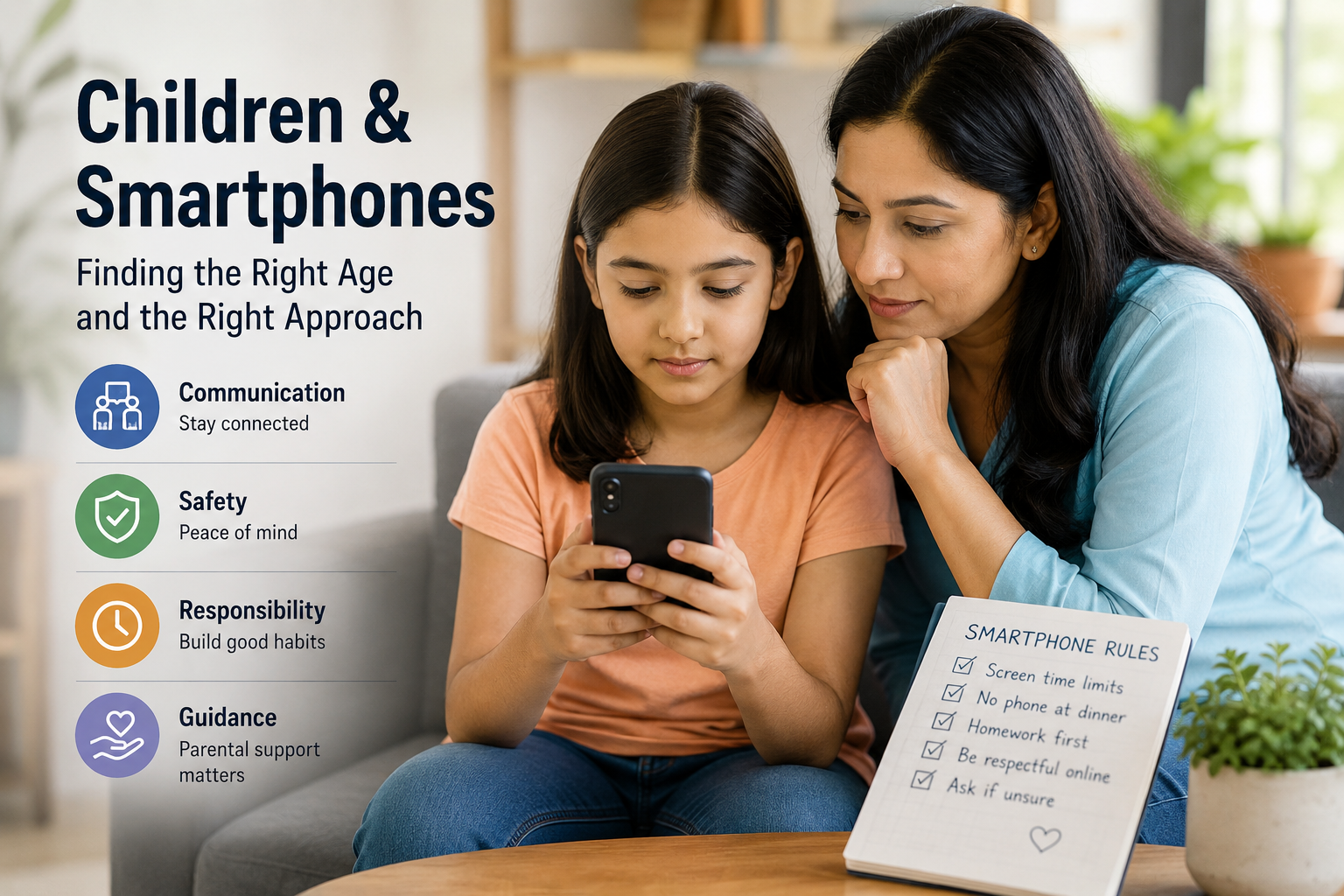
Children and Smartphones: The Right Age May Be the Wrong Question
For many parents, the question sounds simple: When should my child get their first smartphone? But parenting experts increasingly argue that age alone can’t provide the answer. The more important question is whether a child has the maturity, self-control and understanding needed to handle the responsibilities that come with constant digital access.
Table of Contents
Children, Smartphones and the Pressure to Pick an Age
The debate over children and smartphone use often centres on a number. Is 10 too young? Is 12 acceptable? Should parents wait until high school?
The problem with this approach is that children of the same age can have very different levels of emotional and social maturity. One child may reliably follow household rules, manage time and speak openly with parents about problems. Another may struggle with limits, become highly distressed when a device is taken away or lack the judgement needed to navigate difficult online interactions.
That distinction sits at the centre of advice highlighted by parenting experts: a child’s readiness matters more than simply reaching a particular birthday. Parents should consider whether their child can follow agreed rules, manage screen time and respond responsibly to social situations before handing over a smartphone.
Research involving young people themselves points in a similar direction. In a University of Michigan-linked survey of 469 participants aged 14 to 24, respondents reported receiving their first phone at an average age of 12.2 years. Their average recommended age for phone ownership was 12.7, but the reasons behind the recommendation mattered as much as the number: necessity, independence and maturity repeatedly shaped their views.
That suggests parents may benefit from moving beyond a single question of age and instead asking what role the device will actually play in a child’s life.
Children and Smartphones: Start With Need, Not Peer Pressure
A smartphone can solve real problems. A child travelling independently, attending activities after school or moving between caregivers may need a reliable way to contact parents. But a desire to own the same device as classmates doesn’t automatically create the same need.
The youth survey found that 71.1% of respondents said they received their first phone out of necessity rather than for entertainment or social reasons. Safety, communication and growing independence were recurring reasons for ownership.
This distinction gives parents a practical starting point.
Before buying a smartphone, they can ask:
- Does my child genuinely need a device to communicate or stay safe?
- Can a basic phone or limited-function device meet that need?
- Does my child usually follow rules without constant reminders?
- How do they react when screen time or other privileges end?
- Can they talk to an adult when something online makes them uncomfortable?
The answers may reveal that a child needs a phone, but not necessarily a fully featured smartphone.
That difference is increasingly important. A basic communication device can provide calls and messages without immediately opening the door to unrestricted apps, social platforms and constant internet access.
The Core Decision Isn’t the Phone — It’s the Responsibility
Giving a child a smartphone is often treated as a one-time purchase. In reality, it works better as a gradual transition into digital independence.
Parenting experts cited in the source material recommend a cautious introduction: start with simpler devices where appropriate, establish boundaries and gradually expand a child’s independence as they demonstrate responsible behaviour. Monitoring tools can also help parents manage that transition, particularly during the early stages of smartphone ownership.
The approach reflects a basic parenting principle: freedom works best when responsibility grows alongside it.
A child who has never been expected to manage screen time, respect bedtime rules or discuss online problems openly may struggle when suddenly given unrestricted access to a powerful personal device.
Impact: The First Smartphone Can Set Long-Term Digital Habits
The first smartphone isn’t simply another gadget. For a child, it can become their first largely personal gateway to messaging, entertainment, information and social interaction.
That makes the introduction period significant.
If the phone arrives with no discussion about time limits, privacy, online behaviour or what to do when something goes wrong, parents may find themselves trying to impose rules after habits have already formed. A clearer approach is to establish expectations before the device becomes part of everyday life.
The source guidance also stresses the importance of open communication about online safety, responsible use and the social pressures children may encounter. Parents shouldn’t assume that installing controls alone solves every problem. Technology can support supervision, but conversations remain essential.
Children also learn from what they observe. Parents who expect children to put away their phones during meals or before bed face a harder task if adults in the household rarely follow similar boundaries. Experts therefore encourage parents to model healthy screen habits rather than treating smartphone rules as restrictions meant only for children.
A Readiness Test May Be More Useful Than an Age Rule
For parents of small children, the pressure to decide can begin surprisingly early. Children see smartphones everywhere, and peer influence can make waiting feel difficult.
But the available evidence doesn’t support a universal age that automatically makes every child ready.
Instead, parents can treat smartphone ownership as a series of milestones. A child may first demonstrate responsibility with shared devices. Later, they may use a limited phone for calls and messages. Broader access can follow as they show they can handle rules, independence and social situations responsibly.
This approach also allows families to respond to individual circumstances. A child who regularly travels independently may have a stronger communication need than a younger child who remains under close adult supervision throughout the day.
The research on young people’s own experiences reinforces this point. Participants commonly connected phone ownership with practical needs, growing independence and responsibility rather than simply entertainment.
What Parenting Experts Say Comes Next
The bigger challenge for parents isn’t deciding on one perfect age. It’s preparing children for what comes after the phone enters their lives.
That means setting clear expectations from the start. Parents can decide where the device stays at night, what kind of communication is appropriate, when screens should be put away and how children should respond if they encounter something upsetting or confusing online.
The source material also points to a gradual model of independence rather than an all-or-nothing decision. Parents can begin with more supervision and loosen restrictions as children demonstrate sound judgement and responsible behaviour.
A useful mindset is simple: a smartphone should expand a child’s independence without removing parental guidance overnight.
Conclusion:
There may never be a universally “right” age for a child’s first smartphone. The stronger measure is readiness: maturity, responsibility, communication needs and the ability to follow boundaries all matter.
For parents, that changes the decision from “My child is now old enough” to “My child is ready for this responsibility.” And when the answer is uncertain, starting with a simpler device and introducing digital freedom gradually may offer a more balanced path than rushing to hand over a fully connected smartphone.