

A packet of milk, a phone charger and a tub of ice cream reach your door in about ten minutes, often with a small delivery charge or none at all. So how does Blinkit, the quick-commerce app owned by Eternal (the company earlier called Zomato), make any money on that?
The short answer from its latest results: it makes very little on each order, and a lot of orders.
The answer in brief
- Blinkit handled 398.9 million orders in July–September 2026 (Q2 of FY2026-27), with an average net order value of ₹525.
- Its operating profit (adjusted EBITDA) for the quarter was ₹184 crore. That works out to an estimated ₹4.60 per order, or roughly 0.9% of what customers paid.
- A year earlier it was losing money: an adjusted EBITDA loss of ₹156 crore, or an estimated ₹7 per order.
- It earns in three main ways: a margin on the goods it sells, advertising paid by brands, and charges collected from customers. Scale is what turns those thin slices into profit.
First, what Blinkit actually is
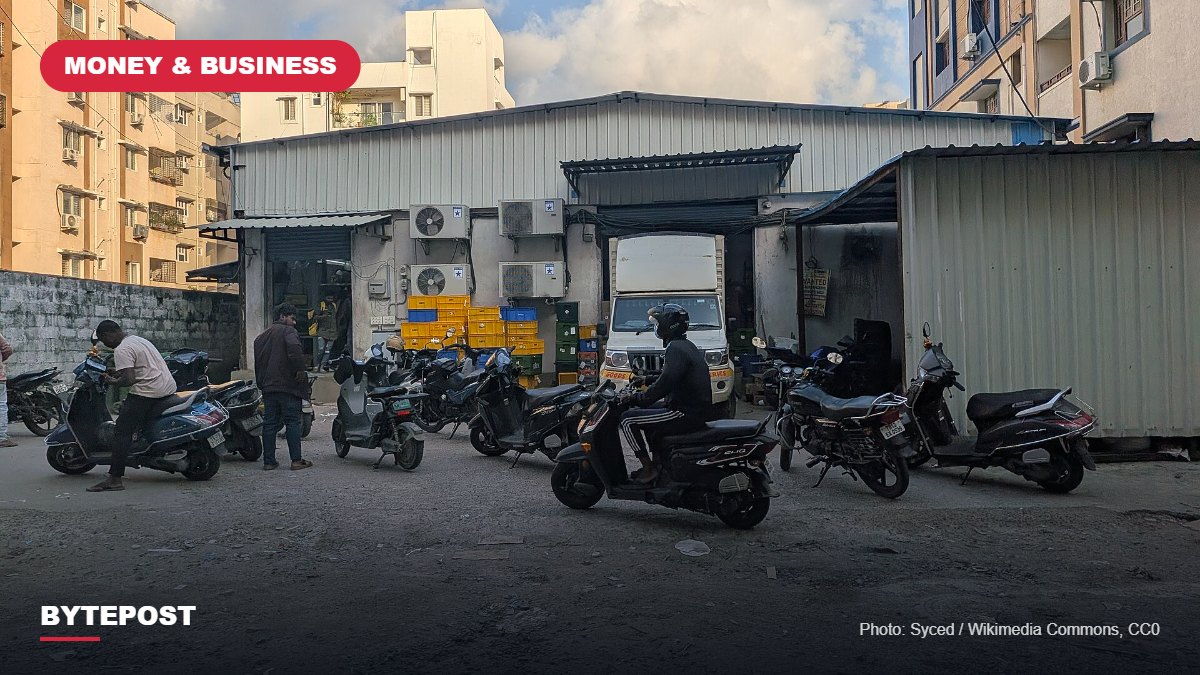
Blinkit does not deliver from supermarkets. It runs its own network of “dark stores”: small warehouses inside residential areas that are closed to walk-in customers. Each one stocks a few thousand fast-moving items, and riders pick up orders from there and deliver within a short radius. A short distance is what makes ten-minute delivery possible.
At the end of September 2026, Blinkit had 2,751 dark stores, after adding 308 in a single quarter, according to MediaNama’s report on Eternal’s results. An average of 37 million customers ordered each month, served by about 6.5 lakh delivery partners.
The three ways Blinkit earns
1. A margin on the goods. Earlier, Blinkit was mostly a marketplace: sellers owned the stock and Blinkit took a commission. Starting in the April–June 2025 quarter, it began moving to an inventory-led model in which it buys the goods and sells them to you directly. Its reported revenue now includes the full value of goods sold, not just a commission. That is the main reason Blinkit’s revenue looks so large: ₹19,152 crore for the quarter, up about 94% from a year earlier, and about 79% of Eternal’s total operating revenue. Owning the stock lets Blinkit keep the gap between its buying price and the selling price.
2. Advertising. When you search for “chips” and one brand shows up first, that placement is often paid for. Brands pay to be seen at the exact moment a customer is about to buy. Eternal’s chief executive Albinder Dhindsa pointed to this in the shareholder letter while talking about newer brands on the app, saying it “allows us to earn advertising revenue as the brands grow”, as quoted by MediaNama.
3. Charges paid by customers. These are the delivery, handling and similar fees you see on the bill. The reports we read do not give a separate figure for Blinkit’s income from these charges or from advertising, so we cannot say how much each one contributes.
The maths of one order
Eternal reports totals for the quarter. Dividing those totals by the number of orders gives a rough picture of a single average order. These per-order figures are our estimates, worked out from the reported numbers; the company does not publish them in this form.
| Per average order, Q2 FY27 | Amount | How it is worked out |
|---|---|---|
| Net order value (what the customer pays for goods, after discounts) | ₹525 | Reported: NOV of ₹20,940 crore ÷ 398.9 million orders |
| Revenue booked by Blinkit | About ₹480 (estimated) | ₹19,152 crore ÷ 398.9 million orders |
| Operating profit (adjusted EBITDA) | About ₹4.60 (estimated) | ₹184 crore ÷ 398.9 million orders |
| Everything else: cost of goods, store rent and staff, rider payouts, packaging, marketing, technology | About ₹475 (estimated) | Revenue minus operating profit |
In other words, out of every ₹100 a customer spends, less than ₹1 is left as operating profit. Adjusted EBITDA is also profit before interest, tax and depreciation, so it is not the final profit.
Two more estimates show why volume matters. Spread over 92 days and an average of about 2,600 stores during the quarter, 398.9 million orders come to roughly 1,670 orders per store per day. And 37 million monthly customers placing about 133 million orders a month means the average customer ordered around 3.6 times a month.
How the numbers changed in one year
| Blinkit | Q2 FY26 (Jul–Sep 2025) | Q2 FY27 (Jul–Sep 2026) |
|---|---|---|
| Orders | 222.7 million | 398.9 million |
| Dark stores | 1,816 | 2,751 |
| Average net order value | ₹524 | ₹525 |
| Adjusted EBITDA | Loss of ₹156 crore | Profit of ₹184 crore |
| Adjusted EBITDA per order (estimated) | About –₹7 | About +₹4.60 |
Notice what did not change: the size of the average order, which stayed at about ₹525. The swing from loss to profit came from more orders (up about 79%) flowing through a network that grew more slowly (stores up about 51%). A dark store has largely fixed costs such as rent, staff and electricity. Once it is busy enough, each extra order adds more to profit than to cost.
This is also why older markets look better than new ones. Blinkit’s mature cities run at an adjusted EBITDA margin above 5%, and cities that bring in about 70% of its order value are already profitable on this measure, Indian Startup News reported from the results. The company-wide margin of 0.9% is low because hundreds of new stores are still filling up.
Why it is still a hard business
- It needs a lot of cash. Eternal’s spending on property and equipment was ₹1,656 crore in the first half of FY27, against ₹788 crore a year earlier. Its inventories doubled from ₹2,181 crore on 31 March 2026 to ₹4,262 crore on 30 September 2026, and its cash balance fell by ₹1,813 crore to ₹16,475 crore during the quarter, according to Indian Startup News.
- It is expanding fast. Blinkit now aims for more than 3,500 stores by March 2027 (up from an earlier target of 3,000) and about 5,000 by March 2028. Every new store loses money until it has enough orders.
- Small cities are a test. Dhindsa wrote that new stores in smaller cities reach 1,000 orders a day about as quickly as metro stores, but also that “some will stay subscale, and we will be disciplined about where we expand”.
- Rivals are still losing money. Swiggy’s Instamart handled 130.3 million orders in the same quarter from 1,240 dark stores and reported an EBITDA loss of ₹895 crore, according to Upstox’s comparison of the two companies. That is an estimated loss of about ₹69 per order, even though Upstox puts Instamart’s average order value higher, at ₹708.
Blinkit versus food delivery
Inside the same company, delivering restaurant food is far more profitable for every rupee of orders, because the platform does not have to buy and store the goods.
| Q2 FY27 | Net order value | Adjusted EBITDA | Margin on order value |
|---|---|---|---|
| Blinkit (quick commerce) | ₹20,940 crore | ₹184 crore | 0.9% |
| Zomato (food delivery) | ₹11,445 crore | ₹627 crore | 5.5% |
Blinkit is now almost twice the size of the food business by order value, but food delivery still earned more than three times as much operating profit. For a similar look at where a company’s real profits come from, see our feature on how IRCTC makes money.
What it means for you
- Convenience has a price, even when delivery looks free. With under ₹5 of profit on an order, the app has little room to give things away. Compare the final bill, including every fee, with your local shop for items you buy often.
- The top result may be an ad. Brands pay for visibility. Scroll a little and compare pack sizes and per-unit prices before adding to the cart.
- Small orders are the costly ones. A rider’s trip costs about the same whether you order one item or ten, which is why apps push you towards a bigger basket. Clubbing your needs into fewer, larger orders usually works out cheaper for you too.
- Service may differ by city. The company has said it will be selective about smaller cities, so store coverage will not be equal everywhere.
The bottom line
Blinkit makes money the way a busy kirana store does, only at enormous scale: a thin margin on goods, plus advertising and fees, multiplied by nearly 400 million orders in three months. Its latest quarter shows the model can turn a profit, about ₹4.60 on an average ₹525 order by our estimate, but only when stores are busy. The heavy spending on new stores and stock is the bet that the same maths will work in thousands more neighbourhoods.
This article is for information only. It is not financial or investment advice and is not a recommendation to buy or sell any share.
Sources
- MediaNama: Eternal clocks Rs 125 crore profit in Q2 FY27, revenue zooms 78% to Rs 24,138 crore (22 October 2026)
- Indian Startup News: Eternal Q2 profit jumps 92% to Rs 125 crore as Blinkit earns Rs 184 crore and targets 3,500 stores (22 October 2026)
- Upstox: Eternal vs Swiggy, how the two fared in Q2 FY27 (26 October 2026)



Leave a Reply